
Light Requirements
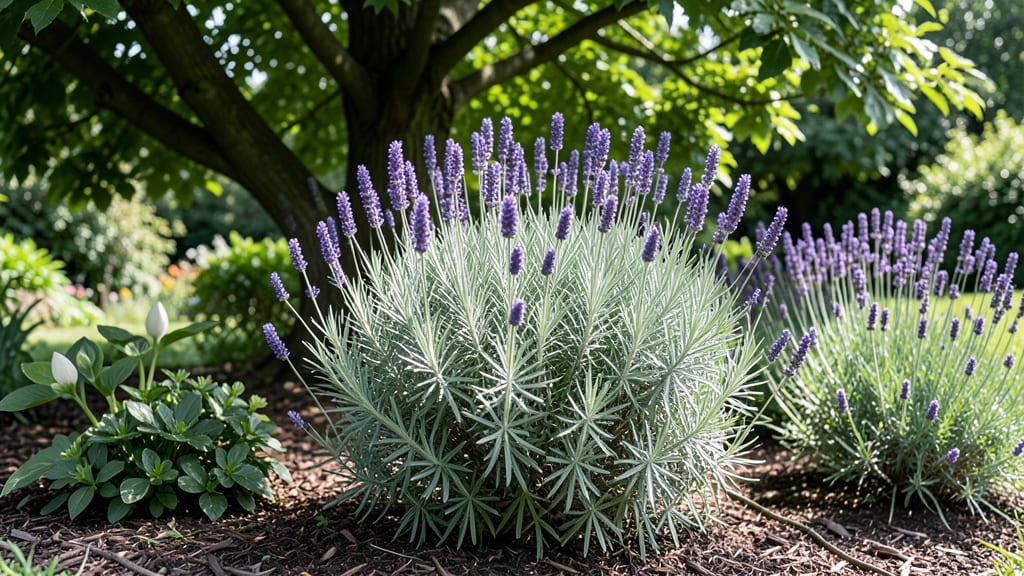
Lavender is shade tolerant but thrives best in full sun, needing at least 6-8 hours daily for optimal growth, fragrance, and flowering. Partial shade slows growth and reduces blooms, while deep shade weakens plants entirely.
While lavender can survive in partial shade, its growth rate, fragrance intensity, and flower production all depend heavily on sunlight exposure. 🌿 The plant's essential oils—what give lavender its signature scent—are produced most efficiently in full sun, where photosynthesis works at peak capacity.
I've seen firsthand how lavender grown in dappled shade might produce fewer blooms but still retains its aromatic qualities, though the stems tend to stretch and become leggy.
For the best results, especially if you're growing lavender for its oil or culinary uses, prioritizing at least 6 hours of direct sunlight is key.
Even in shadier conditions, you can still cultivate healthy lavender by choosing the right varieties and making a few adjustments. Some lavender types, like English lavender, handle partial shade better than others, while Spanish lavender tends to need more sun.
Amending the soil with organic matter and pruning regularly can also help compensate for lower light levels. Just remember—lavender is a sun-lover at heart, and the more light it gets, the more vibrant and fragrant it will be.
💡 In This Article
- How Sunlight Affects Lavender Growth and Flowering
- Maximizing Lavender in Low-Light Gardens
How sunlight affects lavender growth and flowering
Sunlight triggers photosynthesis in lavender, but the intensity directly impacts its chemical processes. Lavender plants convert sunlight into energy through chlorophyll, but they also use light to produce essential oils—the compounds responsible for that signature fragrance.
In full sun (6-8+ hours daily), these oils are synthesized at maximum capacity, resulting in plants that are 30-50% more aromatic than those in partial shade. The extra energy also supports denser flower clusters, with each stem producing 2-3 times more blooms than shade-grown plants.
The difference becomes visible in the plant's structure. Lavender grown in full sun develops thicker, woody stems that support upright growth, while shade-grown plants often produce long, leggy stems with fewer leaves—this is called "etiolation," where the plant stretches toward light sources.
The leaves themselves are smaller in shade, with reduced surface area for oil production. Even the color shifts: sun-grown lavender has deeper purple hues, while shade plants may appear paler or greenish. 🌞
Root development is another critical factor. Lavender has a deep taproot system that needs sunlight to drive photosynthesis and fuel underground growth. In full sun, roots can extend 3-5 feet deep, anchoring the plant and accessing moisture efficiently.
In partial shade, roots often stay shallow and weak, making the plant more susceptible to drought stress. This is why lavender grown in deep shade (less than 3 hours of light) frequently struggles—it can't support its own weight or produce enough energy for survival.
What most gardeners don't realize is how light affects the plant's flowering cycle. Lavender blooms are triggered by a combination of daylight hours and temperature. In full sun, the plant enters its flowering phase earlier in the season and produces blooms for a longer duration.
Shade delays this process, often by 2-4 weeks, and reduces the number of flowers per stem. The buds themselves may also be smaller, with less vibrant coloration.
For those growing lavender for its culinary or medicinal uses, sunlight is even more critical. The essential oil content—what makes lavender valuable for teas, sachets, and aromatherapy—peaks in full sun. Tests show that lavender grown in partial shade can have up to 40% less oil yield per plant.
This is because the oil glands (trichomes) on the leaves and stems require high light levels to develop fully. Even if the plant survives in shade, the quality of its oils will be significantly compromised. 🌿
Consider this comparison: a lavender plant in full sun might reach 2-3 feet tall with abundant blooms, while the same plant in deep shade may only grow to 1 foot tall with sparse flowers.
The trade-off isn't just aesthetics—it's functionality. Whether you're growing lavender for its fragrance, flowers, or oils, sunlight is the single most important factor in determining its success.