
Light Requirements
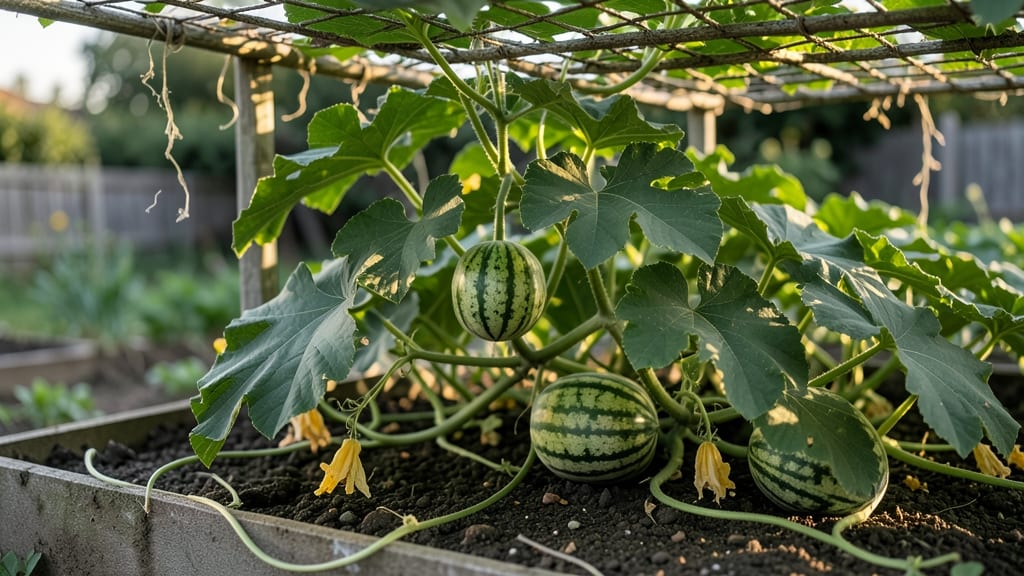
Watermelons can grow in shade but require at least 6-8 hours of direct sunlight daily to develop properly. Partial shade slows vine growth and reduces sweetness, while heavy shade often prevents fruit production entirely.
Watermelons thrive when they get plenty of sunlight because their vines and fruit need energy from photosynthesis to develop properly. 🌞 Without enough light, the plant directs its resources toward leafy growth instead of fruit production, which is why you might end up with small, underdeveloped melons that lack sweetness.
Even partial shade can delay ripening by weeks, so if you're growing watermelons in a shaded spot, choosing shade-tolerant varieties like 'Sugar Baby' or 'Moon and Stars' can improve your chances of success.
For best results, position your plants where they'll get morning sun and afternoon shade, or use reflective surfaces like white mulch or mirrors to bounce extra light onto the vines.
If you're growing in containers, place them in the sunniest spot available and rotate them occasionally to ensure even light exposure. Proper soil moisture and nutrient balance also play a key role—watermelons need consistent watering and rich soil to compensate for reduced sunlight.
💡 In This Article
- How Sunlight Affects Watermelon Growth and Flavor
- Shade-Tolerant Watermelon Varieties and Growing Tips
How sunlight affects watermelon growth and flavor
Watermelons rely on photosynthesis to convert sunlight into the energy needed for growth, and this process directly impacts their sweetness. The plant's leaves contain chlorophyll that absorbs light, primarily in the blue (400-500nm) and red (600-700nm) wavelengths, which are most effective for sugar production.
When watermelons receive 6-8 hours of direct sunlight daily, they produce 10-12% sugar content—the sweetness we crave. In shade, this process slows dramatically, often resulting in melons with only 6-8% sugar, which taste bland or even bitter.
The vine development is equally light-dependent. Watermelon vines can spread 15-20 feet, but in partial shade, they grow leggy and weak, producing fewer flowers. Each flower has a 24-hour window to be pollinated before it drops, and shade reduces both flower production and pollinator activity.
Without adequate light, the plant prioritizes leaf growth over fruit development, leading to stunted melons that rarely reach their full 20-30 pound potential. Even the rind thickens less in shade, making the fruit more susceptible to cracking.
Flavor isn't just about sugar—it's also tied to the plant's ability to develop complex compounds like lycopene (the red pigment) and cucurbitacins (bitter compounds). Sunlight triggers the production of these compounds, giving watermelons their signature deep red flesh and balanced sweetness.
In deep shade, lycopene levels drop by up to 40%, while cucurbitacins can accumulate, creating that unpleasant bitterness. The texture also suffers: sun-grown melons have a crisp, juicy interior, while shaded melons often feel mealy or watery.
Here's what happens at different light levels: Full sun (6-8+ hours) yields optimal growth and flavor, partial shade (3-6 hours) slows ripening by 2-4 weeks, and deep shade (<3 hours) often prevents fruit set entirely.
The key is balancing light exposure with temperature—watermelons need warmth (75-90°F) to complement photosynthesis. In cooler climates, even full sun may not be enough without extending the growing season.
You can test your watermelon's light exposure by observing the leaves: healthy, deep green leaves indicate sufficient light, while pale or yellowing leaves signal a deficiency. The vines should grow outward rather than upward—vertical growth is a classic shade response.
For best results, position plants where they catch morning sun (when temperatures are cooler) and afternoon shade (to prevent heat stress), especially in hot climates where 95°F+ temperatures can scorch leaves.
Even with optimal light, watermelons need consistent care. In shaded conditions, increase watering frequency (watermelons need 1-2 inches of water weekly) and use mulch to retain moisture.
A 5-1 inch layer of straw or wood chips helps regulate soil temperature and reduces evaporation, compensating for the plant's reduced ability to photosynthesize efficiently.