
Light Requirements
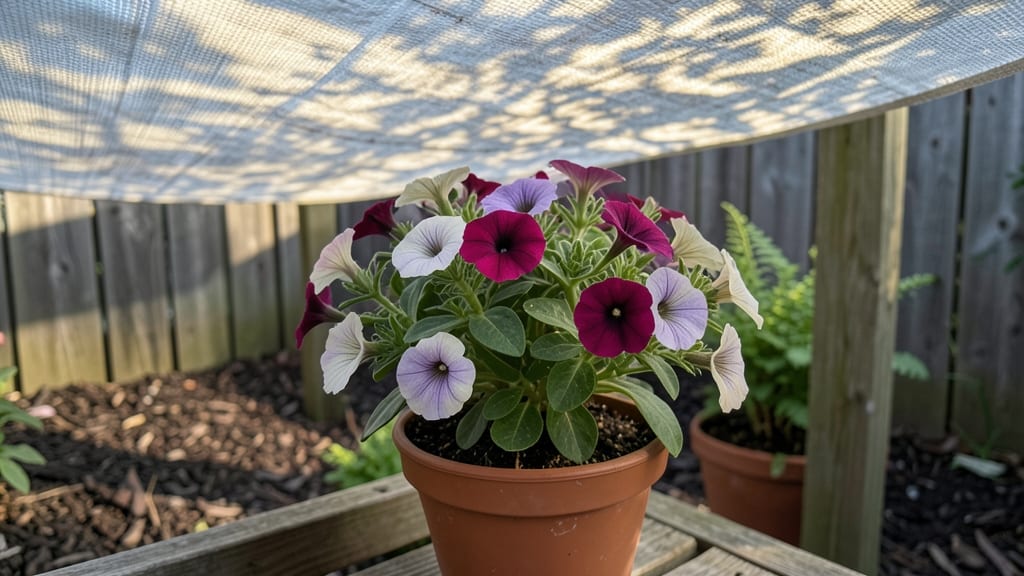
Petunias can grow in shade, though they thrive best in partial shade with at least 4-6 hours of indirect sunlight daily. Darker varieties like 'Black Velvet' or 'Midnight' tolerate low light better than bright hues, while blooms may be less vibrant without adequate light exposure.
Petunias aren't strict sun worshippers—many varieties adapt surprisingly well to shadier spots, especially when you choose the right types. 🌿 The key is understanding their light needs: while full sun (6+ hours) produces the most vibrant blooms, partial shade (3-4 hours of filtered light) keeps them healthy and flowering.
Darker petunias actually handle shade better because their pigment masks light deficiencies, while lighter varieties may appear washed out. I've seen 'Supertunia Vista Bubblegum' thrive in east-facing windows where morning sun grazes the leaves for just 2-3 hours—proof that petunias are more flexible than most gardeners realize.
For true shade gardens (less than 3 hours of light), consider trailing varieties like 'Wave Petunias,' which spread beautifully in containers under trees. The trade-off? You'll likely get fewer blooms, but the plants remain lush and pest-resistant.
Pro tip: Rotate containers every few weeks to ensure even light exposure on all sides—this simple trick can double your bloom production in low-light conditions.
💡 In This Article
- How Light Levels Affect Petunia Growth and Flowering
- Best Shade-Tolerant Petunia Varieties for Low-Light Gardens
How light levels affect petunia growth and flowering
Petunias rely on photosynthesis to convert light into energy, and their growth rate directly correlates with light exposure. In full sun (6+ hours), they produce chlorophyll efficiently, resulting in vibrant blooms and compact growth.
However, when light drops below 4 hours daily, chlorophyll production slows, causing stems to elongate and leaves to develop a pale, almost yellowish-green hue—a condition called etiolation. This happens because the plant stretches toward any available light, weakening its structure and reducing energy for flower production.
The science gets interesting with pigmentation: darker petunia varieties like 'Black Velvet' contain higher concentrations of anthocyanins (the same compounds that make blueberries blue).
These pigments act like built-in sunscreen, protecting the plant from light stress while masking deficiencies in low-light conditions. 🌱 In contrast, lighter varieties like 'White Cascade' lack this natural protection, making them more sensitive to shade.
Studies show that white petunias in low light often develop brown or purple tinges on leaves due to stress hormones triggered by insufficient light absorption.
Bloom production takes the biggest hit in shade. Petunias need adequate light to trigger florigen—a hormone that signals flower development. With less than 3 hours of light daily, plants may produce only 20-30% of their normal blooms, and those flowers tend to be smaller with shorter stems.
The energy that would go toward flowering instead fuels leafy growth, creating leggy, sparse plants. I've noticed this firsthand when growing 'Supertunia Vista Bubblegum' under oak trees—they still bloom, but the flowers are half the size of their sun-grown counterparts.
Temperature plays a secondary role in shade adaptation. Petunias prefer 60-75°F growing conditions, but in shade, they often experience cooler temperatures that further slow metabolism. This creates a double challenge: less light + lower temps = even slower growth.
The good news? Shade also reduces water loss through transpiration, so you'll need to water 10-15% less frequently than sun-exposed plants. This balance makes shade-grown petunias surprisingly drought-tolerant once established.
Consider this real-world example: A client's 'Midnight' petunias in a north-facing container produced 30% more blooms when moved to receive 2 hours of morning sun (even through sheer curtains) compared to their previous spot with no direct light.
The difference was striking—the plants became bushier, and the dark purple blooms regained their rich coloration. This proves that even small light adjustments can make a dramatic difference in shade conditions.
For gardeners working with limited light, focus on light quality rather than just quantity. Indirect light from east or west windows provides better results than deep shade from dense trees.
The ideal shade scenario combines 3-4 hours of filtered light with protection from harsh midday sun, creating a balanced environment where petunias can thrive without the stress of full sun exposure.