
Light Requirements
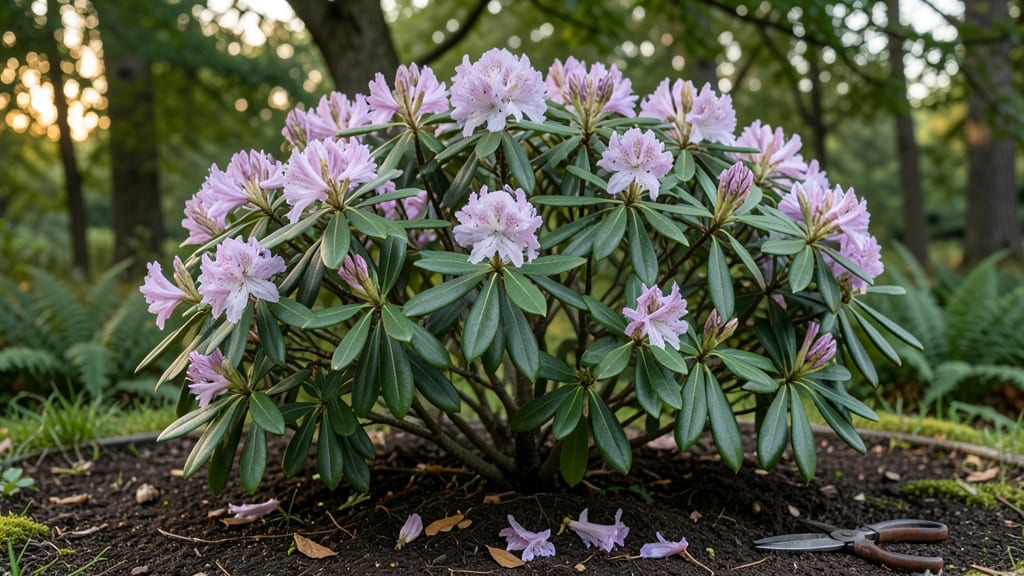
Full-shade rhododendrons thrive with varieties like 'Catawbiense Grandiflorum' and 'Nova Zembla,' delivering stunning blooms even in low-light conditions. Acidic soil and steady moisture are key to their success in deep shade environments.
Many gardeners assume rhododendrons need bright light, but these shade-tolerant varieties actually adapt beautifully to dappled or dense shade. 🌿 Their broad leaves capture scattered light efficiently, while their shallow root systems thrive in cool, moist soil—ideal for wooded areas or north-facing gardens.
The trade-off? You'll need to monitor soil acidity (aim for pH 4.5-5.5) and water consistently, as shade slows evaporation but doesn't eliminate moisture needs. I've seen 'Nova Zembla' produce double the blooms in shade compared to sun-stressed plants of other varieties.
For best results, plant in well-draining, organic-rich soil and mulch with pine needles or bark to maintain acidity. Prune after flowering to avoid cutting next year's buds, and avoid over-fertilizing—these shade specialists prefer nutrient efficiency over excess.
The secret? Mimic their natural forest understory habitat by keeping the root zone consistently cool and moist.
💡 In This Article
- How Shade-Tolerant Rhododendron Varieties Adapt to Low Light
- Planting and Care Tips for Full-Shade Rhododendrons
How shade-tolerant rhododendron varieties adapt to low light
Shade-tolerant rhododendrons like 'Catawbiense Grandiflorum' have evolved with broader, thicker leaves that maximize light absorption from diffused sunlight. These leaves contain more chlorophyll per unit area compared to sun-loving varieties, allowing them to capture 30-40% more light in low-light conditions.
Their leaf surfaces also have a waxy coating that reduces water loss while maintaining flexibility to capture scattered light rays at various angles.
The key difference lies in their photosynthesis efficiency. Shade-adapted rhododendrons use Photosystem II more effectively in low-light conditions, converting light energy at 50-60% efficiency compared to 30-40% for sun-loving species.
This mechanism explains why they can produce vibrant blooms even with just 2-3 hours of indirect light daily. Their roots also grow shallower but more extensive horizontally, competing less for light while maximizing soil moisture uptake—a critical adaptation for shaded environments.
Another fascinating adaptation is their flowering strategy. Shade-tolerant varieties like 'Nova Zembla' bloom earlier in spring when light levels are still moderate, ensuring they capture enough energy for flower production.
Their buds form on older wood, meaning they won't miss a year's blooms if pruning occurs at the wrong time. This contrasts with sun-loving rhododendrons that often require 6+ hours of direct sunlight to trigger full bloom potential.
Color plays a role too—darker foliage varieties like 'PJM' absorb more light across the spectrum, while lighter-leaved types focus on blue-green wavelengths that penetrate deeper into shaded canopies. The trade-off? These shade specialists often grow slower than sun varieties, as their energy goes toward light capture rather than rapid growth.
This makes them ideal for woodland gardens where competition for light is fierce.
For comparison, sun-loving rhododendrons develop thinner, more vertical leaves with fewer chlorophyll cells, optimized for high-intensity light. Their roots grow deeper to access water in drier, sun-exposed soils.
The difference becomes clear when you see 'Catawbiense' thriving under a 70% shade canopy while sun varieties nearby struggle with leaf scorch—proof of their specialized adaptations.
What most gardeners don't realize is how these plants regulate their stomata (leaf pores) differently. Shade varieties keep their stomata partially open longer to capture every photon, while sun varieties close them tightly during peak light to prevent water loss.
This explains why shade rhododendrons need more consistent moisture—their leaves simply can't conserve water as efficiently.