
Shrubs
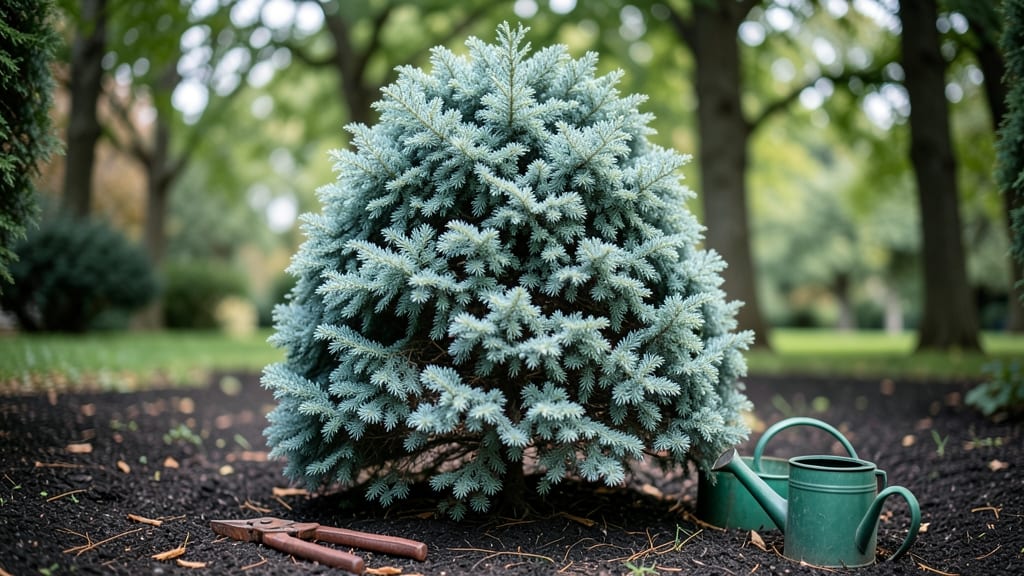
Leyland cypress in shade struggles to thrive, growing only 1-2 feet annually compared to 3-4 feet in full sun, while developing weak stems and sparse foliage. For partial shade, choose varieties like 'Green Giant' or 'Castlewellan Gold', but expect slower growth and less dense branching.
Leyland cypress is a sun-loving evergreen, and its growth habits reflect that preference. 🌿 When deprived of adequate sunlight, the plant undergoes a process called etiolation, where it stretches toward any available light, creating those telltale leggy branches.
The lack of sunlight also reduces chlorophyll production, leading to thinner, paler needles that can't photosynthesize efficiently. While some varieties tolerate partial shade better than others, none will ever match the robust growth seen in full sun conditions.
For gardeners working with shaded landscapes, I recommend selecting shade-tolerant cultivars like 'Green Giant' or 'Castlewellan Gold', which handle low-light conditions better than standard Leyland cypress. Even these varieties will grow more slowly and may develop weaker structural integrity over time.
Consider creating microclimates by planting near reflective surfaces or using windbreaks to maximize whatever sunlight your garden receives.
💡 In This Article
- How Shade Affects Leyland Cypress Growth and Health
- Best Leyland Cypress Varieties for Partial Shade Gardens
How shade affects Leyland cypress growth and health
Shade triggers a biological stress response in Leyland cypress that starts with reduced photosynthesis. These evergreens rely on sunlight to convert carbon dioxide and water into glucose through their needles, which contain chlorophyll—the green pigment that captures light energy.
In shaded conditions, chlorophyll production drops by up to 40%, causing the needles to lose their vibrant green hue and appear dull or yellowish. This deficiency forces the plant to allocate more energy toward survival rather than growth, resulting in slower expansion and weaker structural development.
The most visible effect is etiolation, where the plant stretches its stems toward any available light source. This creates those characteristic leggy branches with sparse foliage, as the plant prioritizes reaching upward over developing dense branching.
In full sun, Leyland cypress grows 3-4 feet annually with compact, bushy growth, while in shade, growth rates plummet to just 1-2 feet per year. The stems also become thinner and more prone to snapping under wind stress, as they lack the structural support developed in sunlight conditions.
Root development suffers too. Shade reduces the plant's ability to produce auxin hormones, which are critical for root expansion and nutrient absorption. Without adequate sunlight, the root system remains shallow and less extensive, making the cypress more vulnerable to drought stress and poor nutrient uptake.
This creates a vicious cycle: weak roots mean less water and nutrient absorption, which further stunts growth and weakens the plant's overall health.
Even the needle texture changes under shade. In full sun, Leyland cypress needles are thick, waxy, and tightly packed, providing excellent moisture retention and protection against pests. In shade, the needles become thinner and more spaced out, losing their protective qualities.
This makes the plant more susceptible to needle blight and other fungal infections, as the reduced chlorophyll can't support the plant's natural defenses as effectively.
What most gardeners don't realize is how shade affects the plant's internal water balance. Without sufficient sunlight, the plant's transpiration rate (water loss through leaves) decreases, leading to excess moisture buildup in the tissues.
This creates ideal conditions for root rot and other moisture-related diseases. The combination of weak structural integrity, poor needle density, and compromised disease resistance makes shaded Leyland cypress particularly challenging to maintain over time.
For a real-world example, consider two Leyland cypress trees planted side by side: one in full sun and one under a 50% shade canopy.
After five years, the sun-exposed tree will likely reach 15-20 feet tall with a dense, pyramid-shaped form, while the shaded tree may only reach 8-10 feet with sparse, elongated branches. The visual difference is dramatic, demonstrating why sunlight is non-negotiable for optimal growth.
The good news is that with proper variety selection and strategic planting, you can mitigate some of these shade-related challenges. Understanding these biological mechanisms helps explain why even the most resilient Leyland cypress varieties will never match their sun-loving counterparts in terms of growth vigor and structural strength. 🌿