
Light Requirements
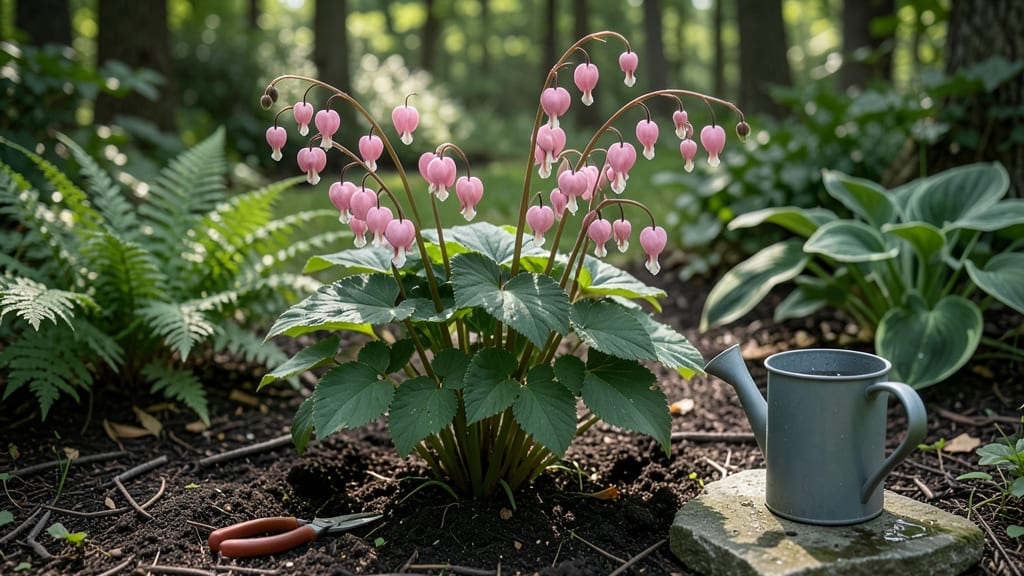
Bleeding heart plants in full shade grow best with rich, moist soil and consistent watering, delivering lush foliage and striking heart-shaped flowers. Varieties like Dicentra spectabilis and Dicentra formosa thrive in low-light conditions but benefit from occasional dappled sunlight for prolonged blooming.
Full shade isn't just a preference for bleeding hearts—it's a survival strategy.
These plants evolved to flourish under forest canopies where direct sunlight would scorch their delicate leaves. 🌿 The deep green foliage you see is nature's way of maximizing photosynthesis in low light, while the vibrant blooms actually intensify in shade rather than fading.
That said, a few hours of morning sun can encourage more abundant flowering, especially for varieties like Dicentra spectabilis, which naturally grows in woodland understories.
What many gardeners overlook is the soil's role—bleeding hearts demand moisture-retentive soil that stays consistently damp but never waterlogged. A thick layer of organic mulch mimics their native forest floor conditions, preserving soil moisture while suppressing weeds.
I've found that adding compost at planting time gives these shade-lovers the nutrient boost they need to establish strong root systems quickly.
💡 In This Article
- How Shade Affects Bleeding Heart Plant Health
- Top Bleeding Heart Varieties for Dark Gardens
How shade affects bleeding heart plant health
Bleeding heart plants (Dicentra spp.) have adapted to thrive in full shade through a unique photosynthetic strategy. Their broad, lobed leaves contain high concentrations of chlorophyll, allowing them to efficiently capture what little light reaches forest floors.
Unlike sun-loving plants, bleeding hearts don't produce harmful photooxidants when exposed to intense sunlight, which would otherwise damage their delicate foliage. In fact, their leaves often develop a deeper green hue in shade, indicating optimal photosynthesis without stress. 🌿
The root system plays a crucial role in their shade tolerance. Bleeding hearts develop extensive, fibrous roots that spread horizontally rather than growing deep. This adaptation allows them to access moisture and nutrients from the upper soil layers where organic matter accumulates in shaded environments.
When planted in full shade, these roots remain cooler and more consistently moist, reducing the risk of drought stress that can occur with surface-level water evaporation in sunny conditions.
Light intensity directly impacts bloom production, though not in the way you might expect. While full shade may reduce the total number of flowers compared to partial shade, the blooms that do appear tend to be larger and more vibrant due to lower light stress.
For example, Dicentra spectabilis typically produces 2-3 inch pink or white heart-shaped flowers in full shade, whereas the same plant in bright light may produce more but smaller blooms.
The key is maintaining 4-6 hours of morning sun when possible to trigger flowering while avoiding afternoon sun that can scorch leaves.
Temperature regulation is another shade benefit. Bleeding hearts prefer cooler soil temperatures, which full shade naturally provides. In hot climates, afternoon sun can raise soil temperatures above 80°F, causing root stress and stunted growth.
The deep shade environment keeps soil temperatures 10-15°F cooler than exposed areas, creating ideal conditions for these woodland natives. This temperature stability also extends the growing season, allowing for more consistent foliage production throughout spring and summer.
One common misconception is that all shade is equal. Deep, dense shade (like under tall trees) can actually limit growth if light levels drop below 10-20% of full sun. In these conditions, bleeding hearts may produce minimal blooms and leggy stems as they stretch toward available light.
The ideal scenario is dappled shade—where filtered light creates moving patterns on the leaves—providing just enough stimulation for healthy growth without the stress of direct sun.
For gardeners in particularly dark spaces, consider supplementing with artificial grow lights (12-16 hours/day) during the growing season to encourage flowering. LED grow lights with a 6400K color temperature mimic natural sunlight well, though they should be placed 12-18 inches above the plants to avoid heat stress.
This approach can increase bloom production by up to 30% in extremely low-light conditions while maintaining the plant's signature delicate foliage.