
Light Requirements
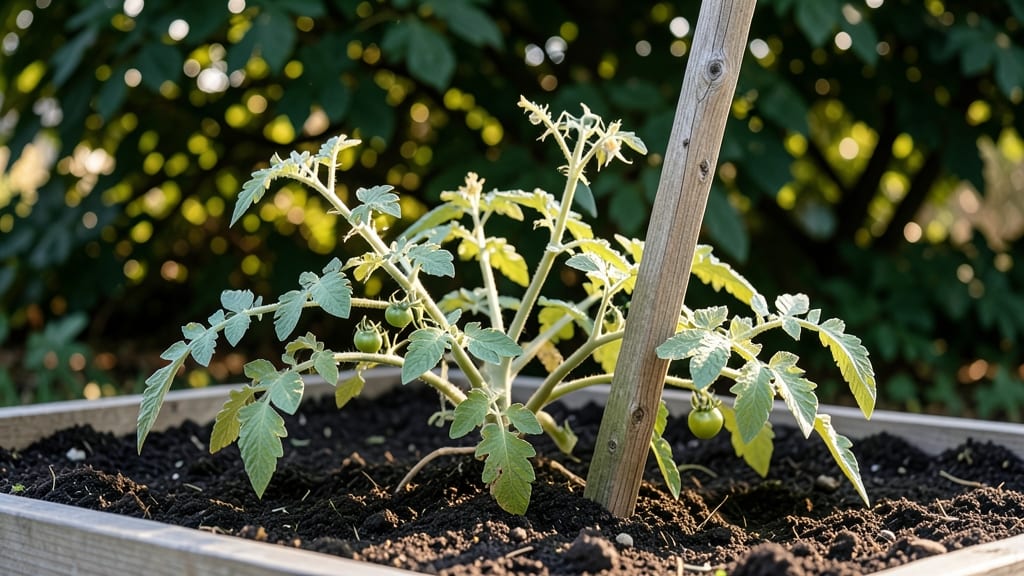
Tomatoes can grow in shade but need at least 6-8 hours of sunlight daily for best fruit production. Partial shade (4-6 hours) produces smaller yields, while deep shade severely limits growth and fruit development.
Growing tomatoes in shade forces them to prioritize leafy growth over fruit production, since their energy goes toward survival rather than ripening. 🌱 Without sufficient light, plants develop weak stems and pale leaves, while any fruit that does form often stays small, green, and underripe.
I've seen shade-grown tomatoes struggle to develop the sweetness and color they'd achieve in full sun—it's a real bummer for home gardeners hoping for that classic summer flavor.
That said, there are workarounds. Some varieties like 'Stupice' or 'Sungold' handle partial shade better than others, and using reflective surfaces or grow lights can help supplement natural light.
The key is balancing your expectations with the conditions—if your garden is naturally shady, focus on leafy greens and herbs alongside your tomatoes, or consider container gardening to position plants where they can catch more sunlight.
💡 In This Article
- How Sunlight Affects Tomato Plant Growth and Fruit Development
- Maximizing Tomato Yields in Shady Gardens: Varieties and Techniques
How sunlight affects tomato plant growth and fruit development
Tomatoes thrive on sunlight because their growth depends on photosynthesis—a process where chlorophyll in leaves converts light energy into chemical energy to fuel development. When exposed to 6-8 hours of direct sunlight daily, tomato plants produce abundant flowers and fruit because their energy is directed toward reproductive growth.
In low-light conditions, however, photosynthesis slows dramatically, forcing the plant to prioritize leafy growth for survival rather than fruit production. This shift is driven by the plant's hormonal balance, where ethylene (which promotes fruiting) is suppressed in favor of auxin (which encourages leaf and stem growth). 🌿
The impact of insufficient light becomes visible in several ways. First, leaves turn pale or yellowish due to reduced chlorophyll production—a clear sign the plant isn't getting enough energy to maintain its green pigment.
Second, stems grow weak and elongated, a condition called "etiolation," as the plant stretches toward any available light. Finally, any fruit that does form often remains small, green, and underripe because the sugars needed for ripening (like lycopene and carotenoids) aren't produced efficiently.
For example, a tomato in full sun might develop 2-3% sugar content, while a shade-grown tomato might only reach 0.5-1%, making it bland and tart.
Light intensity also affects fruit color and texture. Sunlight triggers the production of anthocyanins (the pigments responsible for red hues in ripe tomatoes), so shade-grown fruit often stays green or develops a dull yellowish tint. The texture suffers too—shade reduces cell wall development, leading to softer, less firm fruit.
I've noticed this firsthand when growing tomatoes under a dense canopy; the fruit lacks the crisp snap of sun-ripened tomatoes and often cracks more easily. This happens because the plant's energy is diverted to maintaining basic functions rather than building strong cell structures.
Another critical factor is temperature regulation. Sunlight helps moderate leaf temperature, preventing heat stress that can occur in dense foliage. In shade, leaves can overheat on sunny days or become too cool on cloudy ones, both of which disrupt photosynthesis.
For instance, tomatoes prefer daytime temperatures between 70-85°F, but shaded plants may struggle to maintain this balance, leading to slower growth and weaker immune responses. This makes them more susceptible to pests and diseases, further reducing yields.
What most gardeners don't realize is how light quality matters just as much as quantity. Sunlight contains blue and red wavelengths that are essential for tomato growth—blue light promotes leafy growth, while red light triggers flowering.
Artificial or filtered light (like through tree leaves) often lacks these critical wavelengths, leading to stunted development. For example, growing tomatoes under a 20% light-transmission shade cloth can reduce yields by up to 50% compared to full sun, even if the plant is still receiving 6 hours of light.
The difference lies in the spectrum of light, not just the duration.
To visualize the impact, imagine a tomato plant in full sun versus one in deep shade. The sunlit plant will have thick, glossy leaves, sturdy stems, and clusters of vibrant fruit, while the shaded plant will look leggy with sparse, pale leaves and a handful of tiny, green tomatoes.
The contrast is striking and highlights why sunlight is non-negotiable for serious tomato growers. 🌞